
Alicante, a cyclist's paradise to live in
Every November the towns of Calp, Altea, Dénia and Benidorm fill up with team cars, bike-trailer buses and WorldTour jerseys. Tadej Pogačar (UAE Team Emirates), Jonas Vingegaard (Visma | Lease a Bike), Geraint Thomas, the Yates brothers, Mikel Landa, Primož Roglič: for more than a decade, the world's top professional cyclists have chosen the province of Alicante as their main training base. This is no accident. While Central Europe pedals indoors at 4 °C in the rain, in the Marina Alta and Marina Baixa the sun shines almost every day of the year, the mountain passes lie 30 minutes from the sea, and inland roads are empty.
But this article is not really about the pros. It is about living here. Because exactly the same conditions that have turned Alicante into the international cycling-training mecca have, for years, been drawing thousands of European professionals, retirees, families and digital nomads to settle in.
Why the pros pick Calp and Altea every winter
Three hard data points lie behind the WorldTour teams' decisions:
- Climate. The average January low in Calp is around 8 °C; the high, around 17 °C. Training conditions similar to a Belgian spring. Rainy days are rare.
- Mountain density. In under an hour by bike from central Calp you can reach seven different mountain passes. No other point in the Mediterranean has such a concentration so close to the sea.
- Roads. The inland network (CV-715, CV-720, CV-755, CV-770…) has modern, smooth asphalt and light traffic on weekdays outside tourist season. The Valencian administration has prioritised the resurfacing of these corridors because the Volta a la Comunitat uses them too.
Teams with a regular winter base in the area include UAE Team Emirates in Altea/Calp, Visma | Lease a Bike (formerly Jumbo-Visma) in Calp, INEOS Grenadiers also in Calp, Bahrain Victorious in Dénia, plus Movistar, Soudal-Quick-Step and many U23 and women's teams spread across "bike-friendly" hotels in Calp, Altea and Benidorm.
The big cycling climbs of the province
If you settle anywhere between Dénia and the city of Alicante, these are the climbs you can ride straight from your front door, no car needed. Listed from north to south:
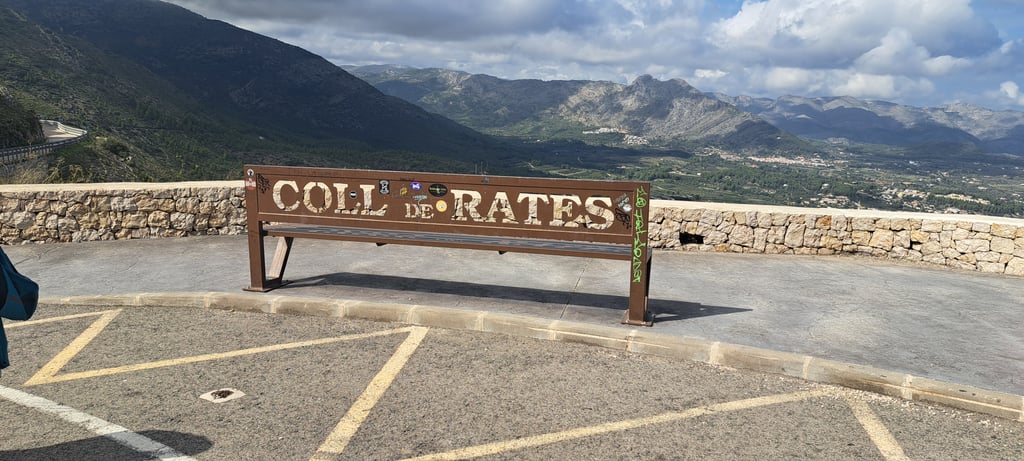
Coll de Rates (Tárbena · Parcent) — 626 m
The most famous climb of the province. 6.5 km at 5.4 % average from the Parcent side, perfect tarmac and views across the entire Marina Alta. It is the pros' fitness-test climb: under 18 minutes means you're in very good shape.
Vall d'Ebo and Vall de Laguar
Two hidden gems in the Marina Alta interior. Vall de Laguar is 8.8 km long with ramps peaking at 13 % — one of the toughest climbs of the Valencian Community. Vall d'Ebo is milder but just as spectacular in scenery (caves, springs, centuries-old pines).
Cumbre del Sol (Benitatxell)
The Vuelta a España has climbed here several times to a summit finish. Short but brutal: 4 km with final ramps of 18 %. Perfect for VO₂max sessions.
Alto de Bèrnia (Altea · Tàrbena)
The eastern side of Bèrnia, climbing from Altea-la-Vella, has one of the most beautiful technical descents in the country. It reaches the foot of the Serra de Bèrnia, a natural balcony over the whole coast.
Confrides — 916 m
A classic climb from the Vall de Guadalest. Clean road, constant panoramas of the reservoir and asphalt in good condition.
Puerto de Tudons — 1,027 m
The high point of the Vuelta when it visits Alicante. A 12-15 km pyramid at 5 % average with max ramps of 8 %. Climbed from Sella, one of the most aesthetic in the Levant.
Alto de la Carrasqueta — 1,024 m
The old road from Alcoy to Xixona. A historic Spanish-cycling climb: 14 km at 4.5 %. Light snow at the summit is possible in winter.
Alto del Maigmó — c. 1,000 m
Approached from Tibi or from Castell de Castalla, on the CV-815. 45 minutes by bike from central Alicante and almost no weekday traffic.
Cabeçó d'Or — 1,209 m
Climbed from Aigües or Busot. One of the few where the upper section is genuinely technical, with 15 % ramps. Unique views of the Bay of Alicante and Cap de l'Horta.
Sierra de Aitana — 1,558 m
The highest peak in the province. The road does not reach the summit, but the approaches (from Sella, from Confrides) are among the most demanding long rides in the Levant. Where the WorldTour closes its 5-hour days.
And then there are the sea ports
The province has nine active commercial and leisure ports, no small matter for anyone thinking about moving here:
- Port of Alicante: cruise ships (regular lines to North Africa and Italy), starting port of four editions of the Volvo Ocean Race.
- Port of Dénia: daily ferries to Mallorca, Ibiza and Formentera (Baleària). For many Marina Alta residents, "going to Mallorca" is as easy as catching a high-speed train.
- Port of Calp: leisure marina with direct view of the Peñón de Ifach rock.
- Port of Altea: mid-sized marina integrated into the old town.
- Port of Moraira (Teulada): upmarket marina with Michelin-starred restaurants.
- Port of El Campello: small fishing and leisure port, charming, with a working fish market.
- Port of Villajoyosa: daily fish auction, multicoloured façades of the old town.
- Port of Santa Pola: deep-sea fishing and daily boat to Tabarca island.
- Port of Torrevieja: large marina next to the famous salt pans with pink flamingos.
Living anywhere on the Alicante coast puts one of these ports under 20 minutes from your home.
The advantages that matter day to day
Beyond the tourist data, here is what makes Alicante a solid place to live:
- Public health with a real network: General University Hospital of Alicante, University Hospital of San Juan, General University Hospital of Elche, Vega Baja, Marina Salud (Dénia), Marina Baixa (Villajoyosa) and Torrevieja Hospital. Coverage is close everywhere in the province.
- Universities: the University of Alicante (UA) in San Vicente del Raspeig and the Miguel Hernández University (UMH) with campuses in Elche, Sant Joan d'Alacant, Orihuela and Altea.
- Alicante-Elche Airport: the second busiest on the Spanish Mediterranean by traffic, with direct flights to more than 90 European destinations. Manchester, Brussels, Amsterdam, Paris, Oslo, Helsinki and Frankfurt are 2-3 hours away.
- AVE high-speed rail to Madrid: 2 h 17 min, frequent service. Compatible with a monthly on-site work commitment in the capital.
- TRAM Metropolitano de Alicante: line L1 connects Alicante-Luceros with Benidorm via Playa de Muchavista, El Campello and Villajoyosa. Living "on the beach" without a car is realistic.
- Reasonable cost of living: housing and consumer prices significantly below Madrid and Barcelona, even in Calp or Jávea. Public services are comparable.
- Established international community: over 100 nationalities on the padrón in Torrevieja, more than 25 % foreign residents in Calp. Strong British, German, Dutch, Norwegian, Swedish, French, Belgian and Italian presence, with bilingual services in everyday life.
What procedures do I need to settle here?
If you have decided to move in, this is the logical sequence:
- Padrón registration at the town hall that covers you (Alicante, Elche, Calp, Dénia… wherever you live). You need a tenancy contract or title deed and your passport.
- NIE (Foreigner Identification Number), essential for any subsequent legal act.
- If you are an EU/EEA citizen: you apply for the Certificate of Registration as an EU Citizen at the Foreigners Office of Alicante.
- If you are a British citizen under the Withdrawal Agreement or from a non-EU country: you apply for the TIE (Foreigner Identity Card) or the relevant pathway (non-lucrative, work, studies, arraigo).
- SIP health card at the health centre assigned to you by padrón.
- Driving licence exchange if you come from outside the EEA. EU drivers do not need to exchange, but for some procedures a translation may still be requested.
- Spanish bank account: most banks open it with your NIE and padrón.
- If you plan to buy a home: NIE required, proof of funds from your foreign bank, deed of sale at the notary.
- Family reunification if you bring a non-EU spouse or children.
What sworn translations will you need
For most of those steps, administrations, registries and notaries will require sworn translation into Spanish of foreign-language documents. Through the MAEC accreditation (Ministry of Foreign Affairs), our translations have full legal validity throughout Spain.
The documents we typically receive from Alicante clients are:
- Criminal record certificate from the country of origin (initial residence, citizenship, public competitions).
- Birth certificate, long form / full copy (Spanish citizenship, registering children in the Civil Registry, family reunification).
- Marriage certificate (to register a marriage celebrated abroad).
- Driving licence (exchanges from non-EU countries).
- University degrees and academic transcripts (homologation at UA or UMH).
- Bank certificates and proof of funds (property transactions, mortgages, demonstrating means).
- Foreign wills (estates of spouses with assets in Spain).
- And The Hague Apostille that accompanies each of those documents.
A practical rule: apostille first, sworn translation afterwards. If you translate before apostilling, the Apostille added later will also need translation, doubling the cost.
In short
Alicante combines something very few regions in the world manage to bring together at once: a stable climate, mountains next to the sea, liveable cities, solid public healthcare and universities, an international airport, high-speed rail to Madrid, an established international community and a Mediterranean culture that keeps its character. That the world's top professional cyclists choose to come here every winter is no coincidence: it is confirmation that the model works, and that anyone — cyclist or not — thinking about a change of life has here a serious proposition.
At Textualia we handle the least visible but most critical piece of that change: the sworn translation from English and French into Spanish of every document you need to register on the padrón, settle your residence, buy a home, homologate your studies or apply for Spanish citizenship. Instant closed quote in the calculator, MAEC-accredited translator, electronically signed PDF within 24-72 hours and, if needed, a physical copy by certified courier within 1-2 business days to any address in the province.